Web & frontend·JavaScript·Archived
Login / Register System
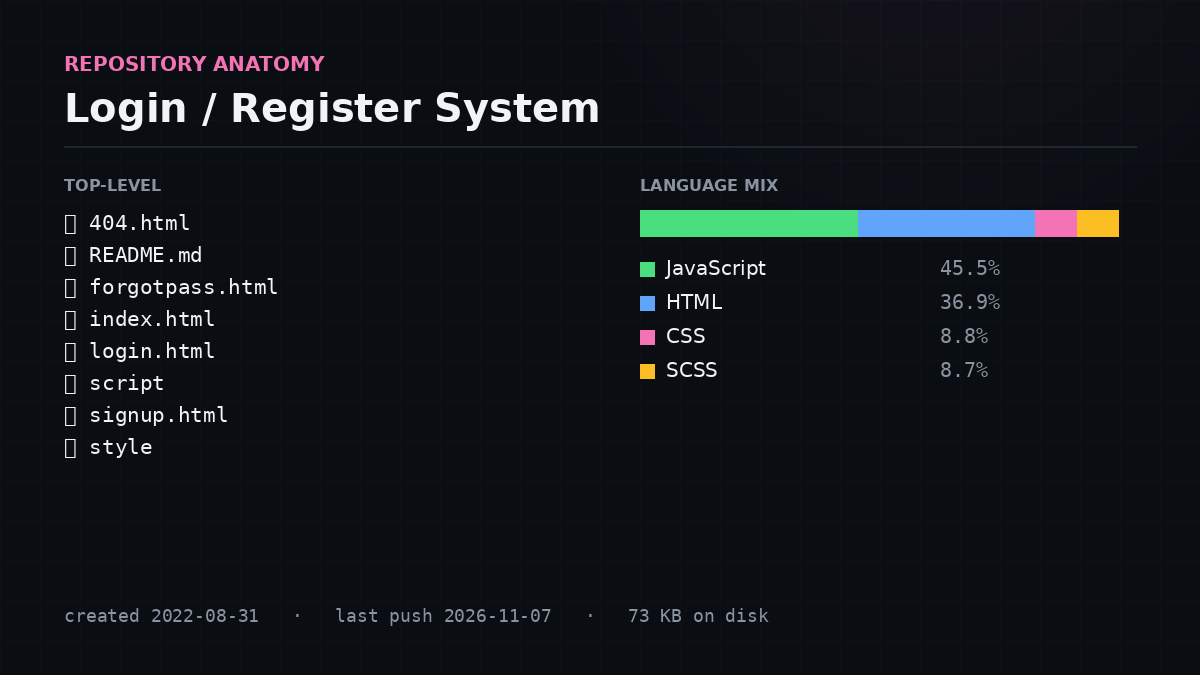
One of my first attempts at a real full-stack flow: registration, login, password reset, and profile editing, built as static HTML/CSS/JS pages talking to Supabase through its JavaScript client. Each screen has its own script file (login.js, signup.js, forgotPass.js, dataParser.js), and profile data lives in a Postgres profiles table keyed by UUID. The signup form enforces a password policy of at least eight characters with mixed case, a number, and two special characters. I hashed passwords with MD5 in the browser before sending them, which I now know was the wrong lesson: MD5 is fast and unsalted and belongs nowhere near credentials, while Supabase Auth already handles hashing correctly. The project still taught me how auth state, client-side validation, and a hosted database fit together before I understood any of it.


- Never hash credentials with MD5 in client code; use the auth provider's own hashing instead of inventing one.
- Splitting page logic into one script per screen keeps a static multi-page app readable.
- Password policy checks on the form are for UX only; the real enforcement has to live behind the API.
Scale 0–100: how much this project relied on each skill.