Quant research & trading·Python·Published
TradingAgents
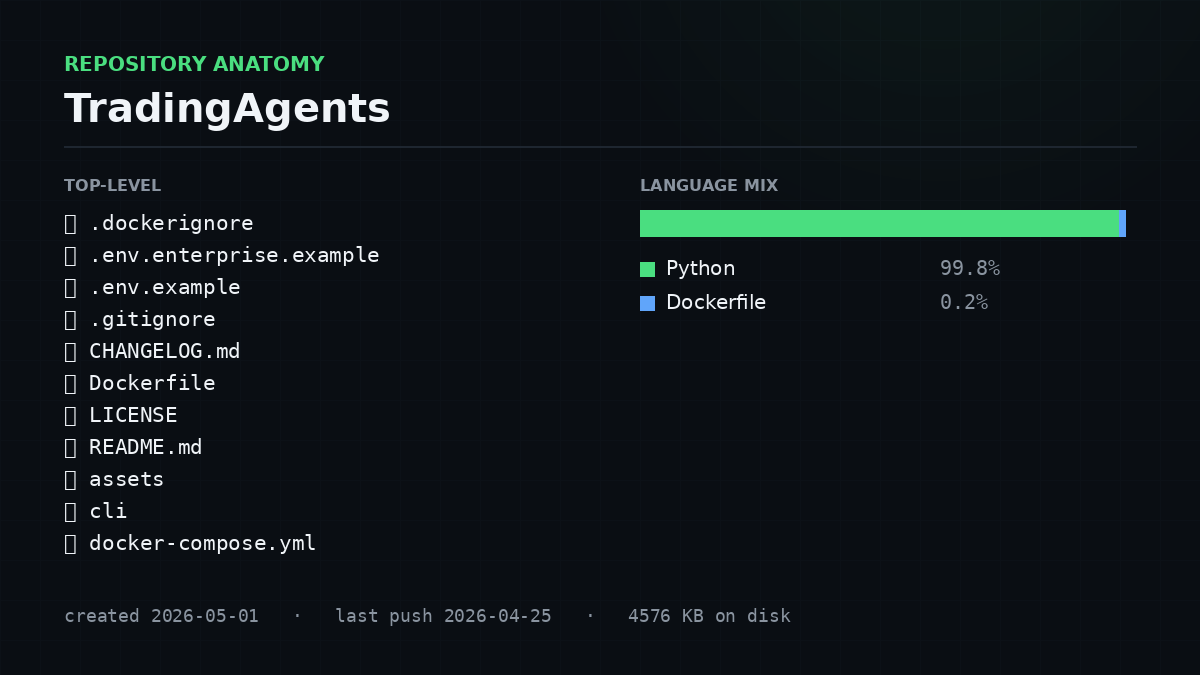
A fork of TauricResearch/TradingAgents (upstream at v0.2.4), the multi-agent LLM trading framework that splits analysis into fundamentals, sentiment, news and technical analysts, then runs bull and bear researchers through structured debate before a trader and risk team produce a decision. I use the fork as a reference for how to structure a long LLM workflow properly: it is built on LangGraph, supports OpenAI, Google, Anthropic, xAI, DeepSeek, Qwen, GLM, OpenRouter, Ollama and Azure OpenAI, and separates a deep-thinking model from a quick one. What I find worth copying is the persistence, not the agent count: an always-on decision log at ~/.tradingagents/memory/trading_memory.md appends each decision with its realised return and alpha versus SPY, then injects those reflections into the next Portfolio Manager prompt. Optional checkpoint resume writes LangGraph state after every node into a per-ticker SQLite file, so a crashed run continues from the last successful step instead of restarting the whole graph. The code is upstream work; the value I take from it is the architecture.
- A multi-agent system earns its cost through role separation and structured output contracts, not through adding more agents; the Research Manager, Trader and Portfolio Manager schemas are what stop the debate from degenerating into prose.
- Checkpointing per graph node in SQLite turns an expensive LLM pipeline from all-or-nothing into resumable, which matters more as the graph grows than any prompt tweak.
- A reflection loop needs an external score (realised return, alpha vs SPY) or it just reinforces its own reasoning; self-critique without ground truth drifts.
Scale 0–100: how much this project relied on each skill.